


JetSynthesys-MIXI Partnership— India’s claim to a bigger pie in global gaming industry
The JetSynthesys–MIXI partnership may look like another corporate MoU. Look closer, and it reflects something much larger happening inside India’s gaming economy.
For years, whenever we spoke about the future of gaming in India, one number usually dominated the conversation: the number of gamers. It made sense. But I think that description is gradually becoming outdated. The more interesting question today is no longer simply how many Indians play games?
It is: How much of the global gaming ecosystem can India actually build, own and influence?
In last one and half decade India has made unprecedented progress in digital smartphone penetration in rural India, inexpensive mobile data, a young population and hundreds of millions of people discovering digital entertainment. Naturally, the global creator industry looked at India as an enormous consumer market. Even though, personally I consider this progress more of a consumer centric behavioural progress than a substantial economic development. An underemployed tech grad buying an iphone in EMI is not what I feel economic growth should look like. However, that’s a different topic altogether.
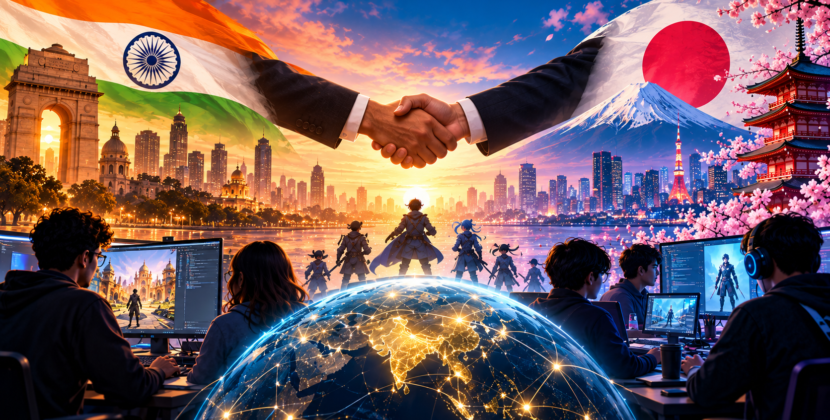
The recently announced Memorandum of Understanding between Indian digital entertainment company JetSynthesys and Japan’s MIXI makes that question particularly relevant. The two companies will explore collaboration across game development and publishing, esports, marketing and user acquisition, market intelligence, business development and even potential strategic investments.
On paper, it is an MoU. In the larger story of Indian gaming, however, it may represent something more interesting- the growing convergence of India’s scale with global gaming expertise.
Why MIXI’s Interest in India Matters
MIXI isn’t approaching India as a complete outsider testing an unfamiliar market. The Japanese company has already been building its understanding of the country. Its global version of Monster Strike, called STRIKE WORLD, began full-scale operations in India in April 2026.
MIXI has also been looking at India from an investment perspective. Through MIXI Global Investments, the company established a $50 million corporate venture capital fund focused on India, with investments across digital entertainment, lifestyle and sports businesses.
That context changes how we should look at the new JetSynthesys relationship. This isn’t simply about bringing a Japanese game to Indian smartphones.
It potentially connects capital, publishing expertise, intellectual property, game development, esports, distribution and local market intelligence. And that is precisely where India’s gaming story needs to move next.
India Has Already Solved the Audience Problem
India doesn’t need to prove that Indians like gaming. The audience is already here.
Research from Lumikai has previously estimated hundreds of millions of active gamers in the country, with a significant majority coming from non-metro markets. More recent research points to gaming becoming part of a much broader interactive-media economy where people don’t simply consume content — they participate in it.
That distinction matters enormously.
- A television viewer consumes.
- A gamer interacts.
- A creator contributes.
- An esports player competes.
- A developer builds.
- A publisher distributes.
- An investor finances.
And an IP owner potentially earns from all of them.
So the real economic opportunity in gaming isn’t created merely by increasing the number of people playing games. It comes from increasing India’s participation across this entire value chain.
The Next Battle Is Over Intellectual Property
This, in my opinion is where the conversation becomes much more crucial. India can become one of the world’s largest gaming markets and still capture only a fraction of the industry’s long-term value if most successful intellectual properties, publishing networks and platforms continue to originate elsewhere. There is nothing inherently wrong with international games succeeding in India. Gaming has always been a global cultural industry.
The opportunity is to make the flow increasingly two-way. Can a game conceived in Pune, Kolkata, Bengaluru, Hyderabad or Guwahati eventually find players in Tokyo, Seoul, London or São Paulo?
Also Read: Can Namit Malhotra’s Ramayana open new doors for Indian VFX?
Can Indian mythology inspire global franchises without every Indian game becoming another predictable mythology adaptation? Can our developers create entirely new characters, worlds and gameplay mechanics? Possibly, can an Indian studio build something that survives for ten or fifteen years rather than disappearing after its first funding cycle?
These are harder questions than acquiring users. But these are also the questions that determine whether India becomes merely a large gaming market or eventually a gaming nation.
To my understanding, our indigenous gaming studios and creators mostly hustle for procuring investments, merchandising a w.i.p game, creating intermittent buzz while by the time the final product sees the limelight- the audience has already switched their attention to something else. This is not an industry problem but rather a perspective issue. Until and unless the government and the society as a whole learns to see through the cloud of their past conditionings about games- it can never become a credible contributor in Indian economy.
Lately, government of Telengana, Maharashtra, Tamil Nadu as well as our Union government are taking commendable initiatives to ride the growth of global gaming industry. Recent appointment of Shruti Verma as the CEO of GDAI also unlocks a plethora of hopes for the industry and young creators as well. Advancements and changes in last couple of years can give the much awaited impetus to Indian gaming industry.
Japan Offers an Interesting Lesson
Japan’s influence on global entertainment was never built merely by having a large domestic audience. It built intellectual properties. Mario. Pokémon. Final Fantasy. Dragon Quest. Sonic. Monster Hunter.
Individual franchises became cultural exports. Games expanded into animation, merchandise, films, communities, competitions and businesses that survived across generations.
MIXI’s own Monster Strike is another example of how a mobile game can evolve beyond the boundaries of a single application and develop a much larger entertainment identity.
India does not need to imitate the Japanese gaming industry. But through this JetSynthesys–MIXI partnership we can certainly learn something from the philosophy behind it:
Build worlds, not just products.
A successful game may generate downloads. A successful IP can generate an ecosystem.
And This Is Where JetSynthesys Becomes Interesting
JetSynthesys occupies an unusual position within India’s digital entertainment landscape because its activities already stretch across gaming, esports, creators, publishing and entertainment IP.
Its portfolio includes game development as well as esports operations, while the company has also worked with international gaming companies and entertainment properties. That makes the potential JetSynthesys–MIXI partnership more interesting than a conventional distribution agreement.
JetSynthesys brings something international companies desperately need in India: contextual intelligence. India is not one homogeneous consumer market. Languages change. Cultural references change. Purchasing behaviour changes. Devices change. Internet quality changes.
Even attitudes towards gaming can change dramatically between households and regions. Understanding those nuances is difficult from thousands of kilometres away. A strong Indian partner can therefore provide something that cannot simply be downloaded from a market-research report: lived knowledge of the consumer.
Conversely, Japanese gaming companies bring decades of experience in designing, operating and monetising entertainment properties. Put those capabilities together intelligently, and collaboration can move beyond localisation towards co-creation.
Become a Professional Game Developer in 12 months
The Biggest Opportunity May Actually Be Talent
There is another side of this development that deserves far more attention. Students.
If international gaming companies increasingly view India not only as a consumer market but as a development, publishing and investment destination, the skills demanded from young Indians will inevitably evolve. The industry will need programmers, certainly.
But it will also need game designers, technical artists, 3D artists, animators, narrative designers, UI/UX designers, sound designers, producers, esports professionals, community managers, data analysts, product managers and specialists working with AI-assisted production pipelines.
This is where our education ecosystem has to catch up. Teaching somebody Unity or Unreal Engine is not the same as preparing somebody for the transitioning gaming industry. Software proficiency is only one layer. Students need to understand player psychology, storytelling, systems thinking, monetisation, game economies, collaborative production, intellectual property, cultural localisation, community building and — perhaps most importantly — how multidisciplinary teams actually build products together.
Gaming sits at a fascinating intersection of technology, art, psychology, storytelling and business.
Our education system must start treating it accordingly.
India Should Avoid Becoming the World’s Gaming Back Office
There is also a risk hidden inside all this optimism. India has exceptional technical and creative talent. That makes it attractive for outsourced development, art production, testing, animation, localisation and support services.
Those opportunities create jobs and should absolutely be welcomed.
But outsourcing alone should not become the final destination. Over dependence on outsourced projects is one of the key reasons for obliteration of Indian Animation and VFX industry. Likewise, the volatility of Indian IT industry is also a product of this overdependence on outsourced projects.
We have already seen this pattern elsewhere in technology: Indian professionals contribute significantly to global products while ownership of the most valuable platforms and intellectual properties remains concentrated outside India.
Gaming gives us an opportunity to write a somewhat different story. Services can build capability. Capability can build studios. Studios can build products. Products can become intellectual property.
And intellectual property can eventually become cultural influence. That progression should matter.
From “Made in India” to “Imagined in India”
Perhaps the most exciting future for Indian gaming isn’t simply Made in India.
It is Imagined in India. A gaming ecosystem where Indian studios develop original worlds. Where international companies collaborate with Indian creators rather than simply selling to Indian consumers. This is where students see game development as a legitimate intersection of engineering, design, storytelling and entrepreneurship. Where esports develop sustainable professional pathways.</p>
Where investors finance original IP rather than endlessly chasing copies of whatever genre happens to be fashionable. And where an Indian game doesn’t need to look “Indian” to prove that it came from India. That is an important distinction.
Japanese creators didn’t conquer global popular culture by constantly reminding audiences that their products were Japanese. They created experiences people wanted. India’s gaming industry eventually has to do the same.
An MoU Is Only a Beginning
Of course, we should keep the announcement in perspective. An MoU represents intent, not outcome.
The meaningful questions will come later. What products actually emerge? Will there be co-developed games? Can Indian developers gain access to international publishing opportunities? Will investments create original intellectual property? Will knowledge move in both directions?</p>
And most importantly, will any of these collaborations create globally relevant entertainment originating from India?
Those outcomes will matter far more than the announcement itself. But the direction is worth watching. For a long time, the world looked at India and saw hundreds of millions of potential players. Increasingly, it is beginning to see developers, creators, esports athletes, studios, entrepreneurs and intellectual property.
That is a far more exciting identity. India has already proved that it can play. The next chapter is about whether we can build the games the rest of the world wants to play.
Follow us to know more about the transitioning ecosystem of technology, art, science and human behaviour.
Subhodip Ghosh writes about emerging technology, gaming, education, skills, human behaviour and the evolving relationship between industry and the future of work.